Beautiful Plants For Your Interior
In today’s continuously upgrading global cocoa processing industry, process technology has become the core of corporate competitiveness. To provide customers with more stable, efficient, and market-oriented cocoa processing solutions, GELGOOG has continuously increased its investment in cocoa processing technology research and development over the years.
Through continuous experimentation, optimization, and validation, we have built industry-leading capabilities in the complete processing of cocoa powder, cocoa liquor, and cocoa butter.

Cocoa processing is an extremely complex food engineering process; every step, from raw beans to finished product, affects the final quality.
GELGOOG adheres to the principle of multiple trials and repeated verification in process development, focusing on continuous research and development in the following key steps:
1. Roasting Curve Experiment
Cocoa beans from different countries and varieties exhibit significant differences in moisture content and flavor. To find the most suitable roasting parameters, we conducted hundreds of tests on:
All to ensure our customers achieve the ideal aroma and color in their actual production.
2. Shelling and Crushing Efficiency Experiment
The proportion of cocoa shells and the maturity of the beans affect the crushing particle size. The GELGOOG engineering team adjusted the air separation speed and blade angle multiple times to ensure cleaner separation of cocoa nibs, improving the efficiency of subsequent fat extraction and grinding.
3. Cocoa Liquor Fineness and Homogenization Experiment
To help customers meet industry requirements (fineness of 18–22μm), we invested significant experimental time testing the grinding disc material, pressure, and temperature control of the grinding machine, resulting in a finer texture and more stable fluidity of the finished product.
4. Alkalization Process Research
Different alkalization methods directly affect:
Based on dozens of experiments, GELGOOG has developed three types of cocoa powder process models: light, medium, and dark, providing customers with clearer choices.
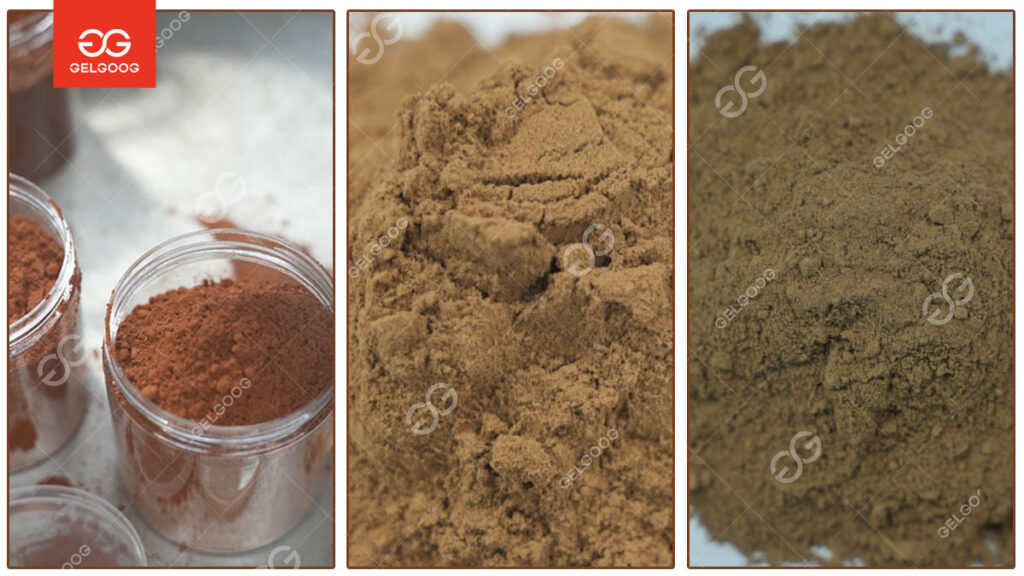
Process testing is not only conducted in the laboratory but also drives the iterative improvement of equipment design.
Over several years of testing, we have implemented more than ten equipment optimizations based on customer feedback and test results:
The continuously improved equipment ensures more stable operation of the entire production line, lower energy consumption, and more consistent final products.
We understand that our clients are not investing in just a machine, but in a production line that can be truly implemented and operational.
Therefore, before the implementation of every cocoa processing project, GELGOOG conducts corresponding trial runs and validations based on the client’s cocoa bean source, target finished products, and market demands:
Ensuring that each production line not only runs smoothly but also produces stable and marketable finished products.
Investing time in process development, delivering results to clients
There are no shortcuts in cocoa processing technology.
The reason GELGOOG has been able to establish deep collaborations with multiple clients in Africa, South America, and the Middle East is precisely because we have done more upfront work:
In the future, we will continue to increase our R&D investment, enabling more countries to move from exporting cocoa raw materials to truly engaging in deep cocoa processing, creating more valuable industrial upgrading solutions for our clients.